.jpg)
I am overdue to write a Palmera Pickleball update. Enough has developed across the land project, the player-development system, our family's competition schedule, and pickleball in Nicaragua that the pieces are best understood together. This is a direct account of where the facility stands, what Palmera is building around it, what competition is teaching us, and how the local sporting ecosystem is taking shape.
1. The destination facility: where the land process stands
Nicaragua is one of the places where our family lives and trains, and many of the relationships behind Palmera were formed here. It is the natural setting for Palmera's first physical chapter.
Our original first priority was the construction of a destination facility inside Rancho Santana. We spent more than a year discussing, planning, and designing that possibility. By Christmas 2025, we concluded that the project needed to be built outside the resort.
The first half of 2026 became a land search along Nicaragua's new coastal highway. We performed diligence on several properties. On one, we executed a purchase agreement and made a deposit, then withdrew when the diligence raised concerns. The money and time spent were real, but they were far less costly than building on unsuitable land.
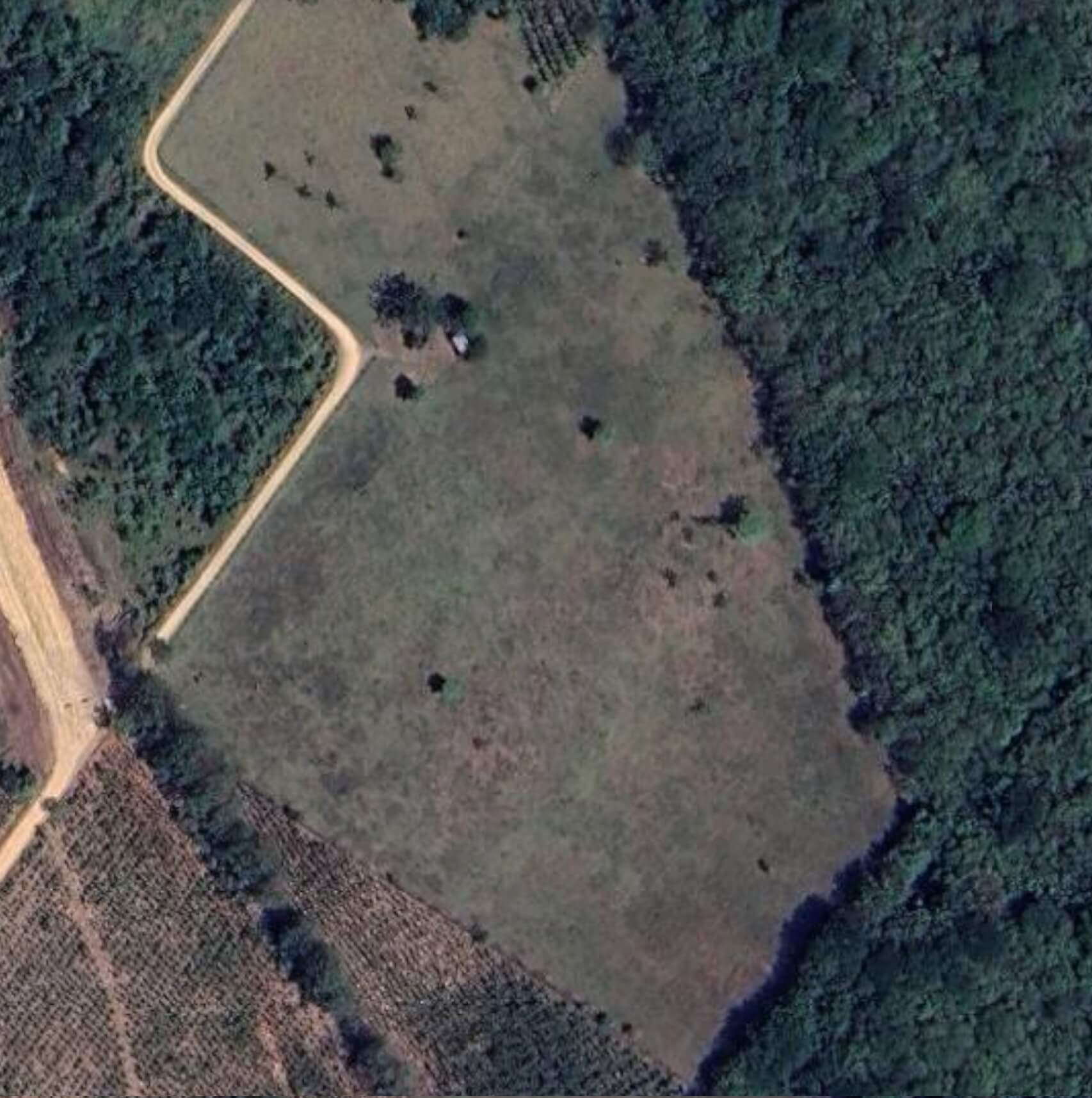
We now have a preferred four-manzana property, roughly seven U.S. acres, across the highway from Rancho Santana and between Rancho and Hacienda Iguana. It sits close to existing pickleball, beaches, resort communities, and tourism infrastructure.
Yesterday, August 10, 2026, I signed the purchase agreement for it!
The principal geotechnical work is complete, and the findings are encouraging. From an engineering perspective, the site appears suitable for the covered, post-tensioned concrete courts we intend to build.
We have also completed the principal technical and legal diligence available at this stage. While the purchase agreement is now signed, there is remaining seller-side entity and title matters that remain conditions to closing. Until those conditions are satisfied, our commitments will remain measured and staged, as they must.
During that period (could be six months), we are evaluating which design, costing, engineering-coordination, permitting, and commercial-approval work can responsibly begin. The aim is to use the time well while keeping the transaction's conditional status clear.
When Palmera launched, I expected the facility to be operating by the end of 2025. I later thought we could pour concrete before the end of 2026. Subject to closing, approvals, and the final construction plan, groundbreaking is now likely to move into early 2027, but with the new land purchase in process, we are positioned to make it happen.
We engaged Johns Design & Consulting early, then paused active design work while the land search changed. If the transaction closes and the project advances, we expect to resume that work at the appropriate stage. Nick Hale continues to build the corporate backbone behind the project: the contracts, accounting, permitting, and operational structure that will allow the physical place to function.
The facility update is straightforward: we have a preferred property; the diligence completed to date is encouraging; the purchase agreement is progressing; closing remains conditional; and we are preparing the next stage without spending the intervening months staring across the highway with pickleballer intensity.
2. The Palmera vision: a place, a method, and a system that travels
Palmera began with a facility-first vision: secure land, pour concrete, and build an exceptional pickleball destination on Nicaragua's Emerald Coast. The time required to secure the right property allowed us space to mature our pickleball game, build relationships in the sport, and refine our understanding of the market opportunity.
The physical place remains essential and continues to be a top priority. Court utilization, programming, staffing, maintenance, hospitality, and disciplined financial management will determine whether the facility is durable and economically sound. The larger purpose, which has always been our deepest passion, is player development: athletes, juniors, seniors, families, coaches, and serious players training, competing, recovering, and refining in a setting designed for the work.
Alongside the facility, we are building an educational platform and knowledge system: athletic-conditioning courseware, performance protocols, match analysis, training frameworks, coaching media, and an archive drawn from actual development. The platform is a core expression of Palmera and will make the work available beyond the facility.
The player-development system can go anywhere.
Working with Kevin Malone
About a year ago, our family began working with Kevin Malone as our athletic-conditioning coach. His work spans strength and conditioning, integrated movement, mobility, breathing, recovery, and nervous-system regulation. He studies the athlete in front of him, the movement demands, the training schedule, the allostatic load, and the longer-term objective.
The difference in how my wife, my children, and I understand our bodies has been substantial. Kevin has worked with us through demanding training blocks, travel, fatigue, interruptions, and setbacks involving feet, ankles, knees, hips, wrists, and vision. His role is athletic conditioning and education (medical diagnosis and treatment remain with the appropriate health professionals).
Kevin helps us adjust load, rebuild capacity, and develop programs, warm-up routines, recovery practices, and daily protocols that support durability. Pickleball repeatedly asks the body to accelerate, decelerate, move laterally, rotate, reach, track visually, change direction, defend from awkward positions, and remain coordinated through long tournament days. Training has to prepare for those demands rather than simply add more hours on court.
This work has also given us a clearer view of what other athletes are managing. Serious players often carry old injuries, recurring limitations, poor recovery habits, travel fatigue, movement inefficiencies, or training loads that have exceeded their current capacity. Talent and youth can hide those issues for a while, but suboptimal habits shape the athlete's future.
We have been in video production with Kevin for more thana month and are developing membership-based athletic-conditioning education for pickleball players. The course roadmap extends over several years. We are still learning, organizing the methodology, testing its usefulness, and building a coaching product worthy of athletes' trust.
Elite one-to-one coaching is expensive and geographically scarce. Our aim is to make high-quality principles and systems accessible to more athletes without reducing them to generic fitness routines with a pickleball label. The courseware is being shaped by movement analysis, real tournament schedules, travel, recovery, return-to-training decisions, and the daily work of preparing bodies for serious play.
This matters especially for pickleball-native juniors. Many will develop extraordinary paddle skill before they have been taught how to generate force, decelerate, recover, regulate attention, or understand training load. Their full athletic development deserves the same care as their hands.
From experience to reusable systems
One system we are formalizing is the Palmera Green Zone Protocol. Between points, the player checks one area, restores physical readiness, and establishes a clear intention for the next rally.
Eyes. Breathing. Grip. Feet. Neck and shoulders. Intent.
The check is practical: are the eyes tracking, is the breath moving, is the grip relaxed, are the feet alive, are the neck and shoulders available, and is the next-point intention clear? A practiced reset helps the athlete recognize a yellow state before it becomes red, with tested techniques for recovering back to a green state before the next point.
Teaching an athlete how to monitor and restore these biometric performance indicators is fun and, in our experience, highly effective. It also has the effect of giving the analytical mind something useful to do so that the body can move freely without interference from an inward, often critical, self monitoring of shot mechanics.
Cameras, journals, match footage, course outlines, and video archives convert our growing experience and research into reusable knowledge. The facility creates training, events, and community. Athletes bring real developmental questions. Coaches help solve them. Competition tests the solutions. Media documents the work, and courseware distributes what proves useful.
Our family supplied the first proving ground, not the boundary. The real test is whether the principles help athletes of different ages, backgrounds, abilities, and ambitions. Pickleball is the first sport in which we intend to develop the methodology carefully. Related applications may come later.
3. The Bourgeois family road to pro
Our YouTube documentary began as Father-Son Road to 5.0, following Jeremy and me as we tried to become genuinely competitive players. The project has expanded into a family Road to Pro. Professional play may become a destination for some, or simply a playground of development with useful structure for everyone.
Our first serious DUPR-rated PPA tournament was Cape Coral in 2025, where Abigail and Jeremy medaled in 3.5 singles. Since then, the calendar has included PPA main events, PPA Challengers, Brick Wall Moneyballs, and local competition. We moved from 3.5 to 4.0 and, during the past six months, increasingly into 4.5. Early 4.5 appearances often ended 0-2. We are now seeing deeper runs, close matches, and longer stretches in which training holds under pressure.
Abigail's DUPR is now the highest in the family at 4.3 and Jeremy's is second at 4.2. As we continue to invest in increasing the quality of our practice, the algorithm will become a more accurate reflection of our true player ratings.
PPA Challengers have become one of our preferred development environments. They combine juniors, ambitious amateurs, emerging professionals, established pros, coaches, and parents in a field where lessons arrive quickly.
Our family's access to strong coaches and players expanded our shot bag faster than our consistency. The current work is to stabilize those skills, sharpen dependable weapons, improve decision-making, and learn to grind out wins. Singles has been especially useful because the full court exposes movement, conditioning, patterns, and emotional control without a partner covering the weakness.
Macon: the latest report card
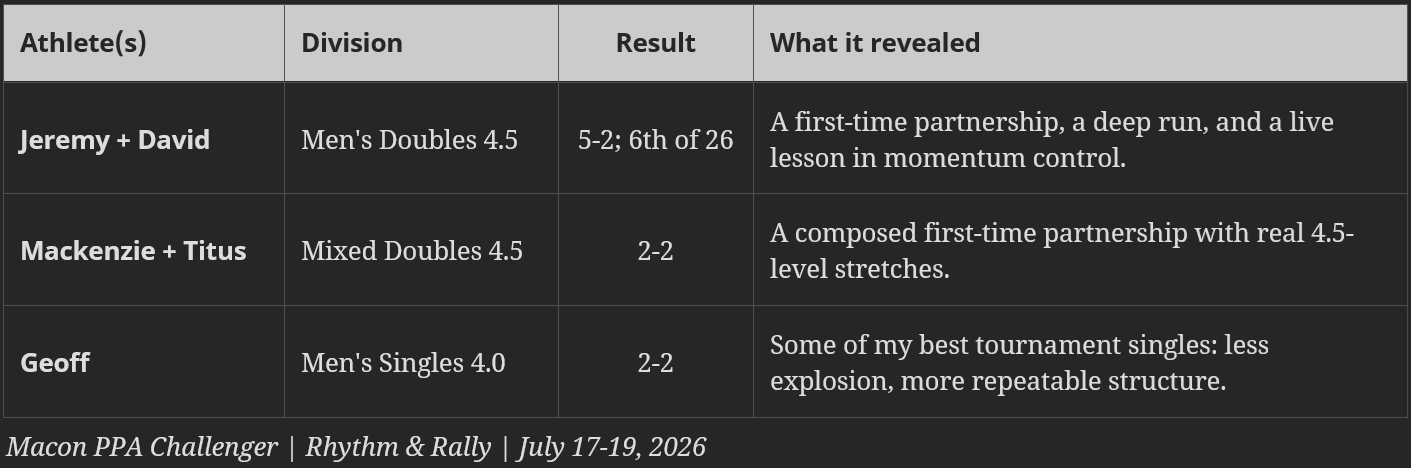
The Macon PPA Challenger, held July 17-19, 2026, at Rhythm & Rally, provided the clearest recent measure of our progress.
The defining moment came during Jeremy and David's 4.5 men's doubles run. They led 13-0 in a game to 15, relaxed, began experimenting, and watched the score tighten to 13-10. By the time I reached the court, they were carrying the entire lost lead into every rally.
I asked them to reverse the score in their minds: pretend they were losing 10-13. The only task was to get the side out, win the next point, and then the next one. They closed the game in the following two rallies.
A lead is not stored value in a secure vault. It has no physical existence. It remains alive only through the next disciplined point.
Jeremy and David finished 5-2 and sixth out of twenty-six teams in their first tournament together. The run reinforced a central lesson: a partnership is its own athlete. Two players bring different error patterns, risk tolerances, stacking instincts, and emotional habits. Shared language, video review, pressure repetitions, and clear roles turn those parts into a functioning team.
.jpg)
Mackenzie went 2-2 in 4.5 mixed with a first-time partner, Titus, showing sustained 4.5-level play. I went 2-2 in 4.0 singles and played with more structure than raw explosion. In one back-draw match, I recovered from 14-9 down to win 16-14 by returning to the patterns and reset routines that had worked earlier.
The next competitive block
Macon opened a compressed competitive schedule that runs through February. The frequency gives us public tests and short feedback cycles.
Tomorrow, August 12, 2026, the family returns to Georgia for more training and competitive reps. We are also scheduled for some meaningful time on the court with pro player Juan Varon.
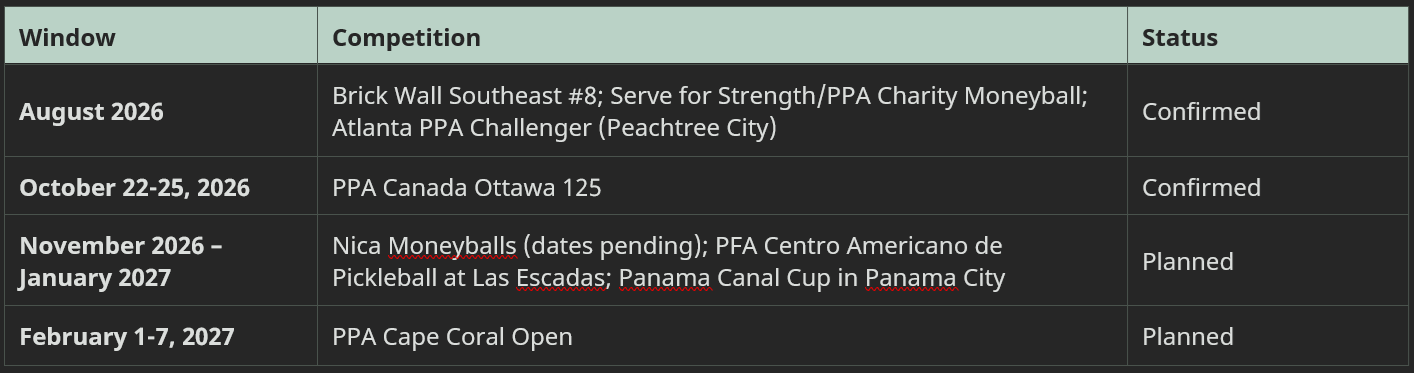
We are excited to execute the above calendar. Each event feeds the same loop: compete, observe, identify the bottleneck, train, recover, and test again.
The next performance milestones are 4.5 medals, credible 5.0 results, and professional qualifiers when readiness and recorded performance justify them. The progression from 3.5 medals in 2025 to credible 4.5 runs in 2026 is meaningful, but the work includes injuries, interruptions, overreaching, family friction, and the steady task of building bodies that can support the ambition. Athletic conditioning is infrastructure for the road ahead.
4. Pickleball in Nicaragua and Central America
While we have been traveling, pickleball across Nicaragua and Central America has continued to grow and organize itself.
Jeremy organized the first Nica Moneyball in Tola with twenty-two teams and forty-four players. Pool play led into brackets, and the field included local players, expats, former tennis coaches, serious tennis players, padel professionals, younger athletes, and older competitors who still know exactly how to strike a ball.
The Moneyballs are community events rather than a profit enterprise. Entry fees largely return through the prize pool, and DUPR reporting adds a useful competitive record. We expect more singles and doubles events, including likely Nica Moneyballs in November and December.
A dependable local circuit matters because training without competition can become self-referential, while constant international travel is expensive and impractical. Moneyballs create frequent pressure, consequences, ratings, and storylines close to home.
Managua is hosting more tournaments, including events at padel clubs, and high-level padel players are beginning to cross over. That movement is important in Central America, where padel already has facilities, athletes, spectators, and a strong Latino racket-sport culture. In September, our family plans to compete in regional events as those pathways continue to develop.
The courts at Rancho Santana and Hacienda Iguana remain active in the Tola-Rivas region. Tourists, local enthusiasts, serious trainees, and social players all use them. Jeremy's events are beginning to draw competitors from Managua, San Juan del Sur, and communities along the coast.
Growth naturally produces different groups. Some players want drills, some want singles, some want organized doubles, and some want relaxed social play. Others arrive ready to release the week's accumulated aggression at shoulder height. A mature ecosystem needs room and programming for all of them.
We are joining a sporting community that already exists. Athletes, families, organizers, coaches, and competitors are building pickleball throughout Nicaragua and Central America. Palmera's contribution can be courts, coaching, events, international connections, and serious player-development resources, provided the facility earns trust and operates well.
Tola before the map notices
I believe the Tola and Popoyo region can become known as a place where serious pickleball players live, visit, and train. Sporting destinations usually form through accumulation: a strong player visits, another returns, a tennis coach crosses over, a padel professional enters a tournament, a family brings new standards home, and the local competitive calendar becomes dependable.
The surf world already knows this geography. Peak One at Playa Santana sits outside our house, and surfers use the house as a marker for where to position themselves for the sets. High-level athletes, including Hayden Patriquin, have visited the region for surf. Pickleball can fit naturally into the same athletic-tourism rhythm: train, recover, surf, work, eat well, sleep, and repeat.
Nicaragua is the setting for Palmera's first physical home, while the methodology, educational platform, and relationships are international by design. Central America has room for a serious destination facility and player-development hub. Before Palmera hosts international competition, it must first earn the right to host an excellent local Tuesday.
The work before the courts
The land project, tournament schedule, courseware, media archive, family development, and Nicaraguan pickleball scene belong to one operating system. The facility gives the work a home. Competition tests the methods. Coaches help solve the problems athletes expose. Media preserves the lessons, and the platform allows them to travel.
The land acquisition remains conditional, and the next construction date will depend on closing, approvals, design, and the final plan. The current work continues in training sessions, competitions, coaching conversations, filmed material, difficult lessons, and relationships forming around the sport.
Nicaragua is the setting for Palmera's first physical chapter, not the outer boundary of what it can become. The facility will house a culture and player-development method already being built, tested, and refined.
The concrete will give the dojo an address. Until then, we are having the time of our lives learning and developing something special.
Let's Connect

%20We%20played%204.webp)